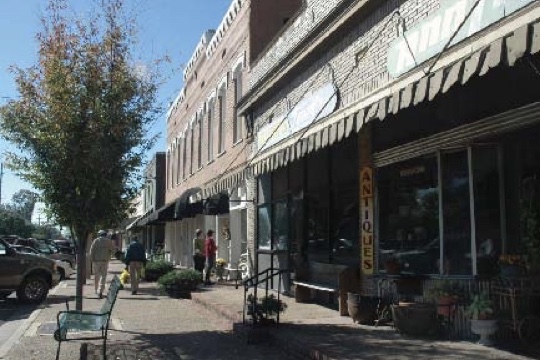


 
Starkville joins Mississippi Main Street program

City of Starkville selected to join Mississippi Main Street Association
JACKSON, Miss. -- On Thursday, Sept. 9, the Mississippi Main Street Association (MMSA) will officially designate the city of Starkville as a Main Street Community. The designation ceremony will be held at 10:30 a.m. at the Greater Starkville Development Partnership (GSDP) office (200 East Main Street) in downtown Starkville.
Starkville will become the 50th Main Street Community in Mississippi and the only community designated for 2010. Speakers at the designation will include: Mike Armour, Director of the Appalachian Regional Commission, Office of the Governor; Bob Wilson, Executive Director of the Mississippi Main Street Association; Parker Wiseman, Mayor of Starkville; and Joy Foy, Director of Asset Development of the Mississippi Development Authority.
"The City of Starkville is in an ideal position to join the Main Street program," Wilson said. "We look forward to working with the current city, university and county leaders as well as other local and regional partners who are investing in downtown Starkville to make it an even better place to live, work and play for residents, students, alumni and visitors."
Jennifer Gregory, Vice President of Tourism for the GSDP, will oversee the Main Street program and Robyn Cain will serve as the Starkville Main Street Program Coordinator. Jan Miller, MMSA Central District Director, has conducted training for committees based on the Main Street Four-Point Approach® - Organization, Promotion, Design and Economic Restructuring. Miller and MMSA staff will work with Gregory and Cain and the Main Street committees on workplans to revitalize and promote downtown Starkville. A Main Street Resource Team will also conduct a design program in Starkville and give recommendations for a long-term master plan for the downtown.
(End)
The Mississippi Main Street Association is an econommic development program of the National Trust for Historic Preservation and the Mississippi Development Authority with many strategic partners. MMSA provides several membership levels and works in more than 70 cities and towns in Mississippi to provide training and technical assistance to the local revitalization programs. Since 1993, MMSA has provided more than $4 billion in public and private re-investment back into Main Street communities. For more information, visit http://www.msmainstreet.com.
Where would Jesus shop?

Where would Jesus shop?
By Anne Gibbons
The News & Advance
Earlier this month I was one of many folks gathered at the new Walmart to receive “good neighbor” checks supporting the work of many local nonprofits. Although I did not tour the entire facility, the building was bright and clean, spacious and colorful, open and ready for business. Within hours, hundreds if not thousands of customers would flood through their doors in search of lower prices and the next rollback bargain.
Several days later I made my weekly trip to Lynchburg Grows to pick up my brown paper bag filled with organic produce from local farms and gardens. Lynchburg Grows is an amazing place. Once-abandoned greenhouses are now filled with thriving rosebushes, nutritious vegetables, and all manner of seasonal produce. Most of the work is done by volunteers, many who have overcome a variety of disabilities and who contribute greatly to the success of this operation. The small building which houses the coolers and from which weekly harvests are distributed is painted on the outside with a colorful mural. Though the number of customers doesn’t begin to rival that of Walmart, those who do support this local business are among the most generous people I know.
As I reflect on these two very different commercial operations, both located in Lynchburg, I couldn’t help but wonder: WWJS? Where would Jesus shop?
For sheer numbers alone, Jesus might find himself wandering the wide aisles of Walmart where a very diverse population of men, women, and children would probably be searching for lower prices as they searched through racks and filled their carts. I picture him striking up conversations with customers, lifting up children to smile at their faces, and listening to stories of those just struggling to make ends meet.
He might then move on to find the managers of the store to learn more about their policies and practices. Jesus might be curious as to how Walmart was able to offer such bargains.
According to an action alert from the National Labor Committee issued on July 28, a certain pair of blue jeans is sold for only $8 at Walmart because the young women garment workers who sew the jeans in Bangladesh are only paid 11½ cents an hour. They are expected to make 10 pairs of jeans an hour, working out to about 1.2 cents a pair. I suspect that Jesus might want to have a frank conversation with corporate managers to challenge the production policies in Third-World countries which contribute in part to the lower prices available at stores like Walmart in our own communities.
I imagine that Jesus would be fascinated, as I was, with the video and PowerPoint highlighting Wal-Mart’s efforts to care for the environment by “boosting energy efficiency, cutting down on waste and reducing greenhouse gases tied to global warming.” In February, Wal-Mart Chief Executive and President Mike Duke announced “an aggressive new goal to eliminate 20 million metric tons of greenhouse gas emissions from the life cycle of the products we sell around the world by 2015.”
I’m guessing Jesus would be happy to hear the news. However, he’d probably also wonder about the effect of such a large store on the surrounding neighborhood and community. The National Trust for Historic Preservation has complained that “big box sprawl induced by mega-retailers such as Wal-Mart robs a state of its uniqueness, causes economic disinvestment in historic downtowns and loss of locally-owned businesses, and removes a sense of community and individuality we all love in our towns.”
After Jesus issued a few gentle challenges to Wal-Mart management, he’d probably give them a hug, wave goodbye to the customers and head down to Lynchburg Grows to visit with Derrick and Keith as Teresa prepared his brown paper bag filled with locally grown fresh peaches, squash and aromatic basil. Then he’d invite the volunteers there and the Wal-Mart employees all over to his place for a shared meal around his kitchen table. I’d love to be there and ask for myself — “So Jesus, where would you shop?”
Gibbons is associate chaplain at Lynchburg College.
Katrina five years later: Bay St. Louis

Katrina five years later: Bay St. Louis
BAY ST. LOUIS, Mississippi (WALA) - TAKING A DIRECT HIT
It was ground zero. Hurricane Katrina sent a 30 foot storm surge crashing into Bay St Louis, Mississippi. Nearly every structure in town was destroyed. Five years later, the town is recovering, battling back from a day that everything changed.
On the day of Katrina, Bay St. Louis was cut off from the rest of the world. Highway 43 was a river and the Highway 90 bridge was blown apart. Folks who stayed were on their own.
SURVIVING AGAINST THE ODDS
Kevin Guillory, who still finds it hard to talk about, survived that day, and according to neighbors he was hero. He came to the aid of several people who stayed behind at the Bay Town Inn.
"My friend calls me and says, 'I'm in trouble,' and I cross back over and it's about knee deep then. But then we get in the house and the waves were breaking at the front door and we had a couch with a ladder holding it back and finally it started coming apart at the hinges, and seven of us and two dogs ended up in room number five," Guillory said.
But the water and the waves kept coming. Guillory tried to keep everyone together as the Inn broke apart.
"We drifted into this tree here and three of us and a dog ended up in this tree, two of us and a dog ended up on a roof down Demontlazon and one got pushed underneath here, swept away, and the trustees found her that afternoon," explained Guillory.
They found her alive. In fact, they all made it through alive, including the dogs. The only thing that died was the tree they clung too. It has now become a landmark with angels carved into the dead limbs.
"The swells would come. They would go underwater and I was on that limb right there and it would slap at me and three and a half hours later we finally decided to come down and take refuge," Guillory said.
RISING FROM UTTER DESTRUCTION
Five years later, Bay St. Louis is gradually being rebuilt, with most of the effort going into Main Street, giving the town a central core.
"It seems like it's really coming together finally," Natasha Ruetten, who runs the Buttercup Café, said.
Ruetten said the revival of Main Street has made a big difference in healing the small community.
"That's the heart of the city," Ruetten said. "If you don't have your heart, then where are you going to go from there?"
The waterfront though, is still a long way from being revived. Many surf-side homes and businesses have never returned. The new normal on the water is to build homes up to 20 feet off the ground.
PICTURING HISTORY
But what has been lost is not completely lost. Remembering what was is part of the mission of the Hancock County Historical Society. They've collected more than 30,000 pictures, street by street, before and after Katrina.
"It draws them back and many people come in and are astounded by what they see and find. It does help ground them. They go back and remember what was," said volunteer Eddie Coleman.
Ironically, Bay St. Louis has the highest elevation on the Gulf Coast. A ridge running through downtown is 25 feet above sea level. However, it wasn't enough to stop the storm surge.
http://www.fox10tv.com/dpp/weather/hurricane/katrina-five-years-later-bay-st-louis
Speakers: Main Street is the heart of economic development

Speakers: Main Street is the heart of economic development
SELMA — If a city builds its downtown, people will come.
That’s the message from Bob Wilson, executive director of Mississippi Main Street Association and guest speaker at a half-day workshop held at the St. James Hotel on Friday.
The worksop was sponsored by Main Street Alabama and the Alabama Black Belt Heritage Area.
Wilson pointed out to about 100 people attending from all over the state that people want to know what’s in it for them when emphasis is placed on the downtown area.
“Your downtown is a reflection of what other people think of you,” he said.
Strong Main Street programs bring in people to the core of downtown by offering shopping and entertainment experiences in a comfortable and safe surrounding, Wilson explained.
As downtown flourishes through the program, more merchants catch on and begin locating downtown.
But that doesn’t alienate malls and retail outlets on the outskirts because people coming and going will stop there as well, he said.
Creating a viable Main Street program takes public and private support which brings in everyday people as well, Wilson added.
He showed some examples of that support. In Greenwood, Miss., Fred Carl of Viking Range worked with Main Street to develop most of downtown into a tourist destination with Viking headquarters, a hotel and spa and a bookstore. Other businesses grew up around the improvements, such as antique stores and dress shops.
Those attending the luncheon and workshops were impressed by Gibson’s presentation, including Candace Johnson, director of tourism for Selma and Dallas County.
“I was very pleased to see this conference being hosted in historic downtown Selma. The speakers were very informative, and I think all who attended benefited from it.”
Johnson pointed to a workshop by Mary Jeanne Packer, called “Enhancing the Visitor Experience in Your Community.”
“One of my favorite points in this workshop was the emphasis she placed on heritage tourism,” Johnson said. “visitors to the Black Belt area want an interactive experience when they visit us. They want to go to the museums to hear the stories of the people there; not to see artifacts with labels of who donated it. They want to purchase local products and dine in locally owned restaurants, not chains. Selma was the perfect setting for this workshop, and I look forward to us playing host to many more.”
Sheryl Smedley, director of the Selma-Dallas County Chamber of Commerce, said she heard what Gibson said about Main Street being the revitalization of traditional historic districts.
“It is the heart and soul of the community,” she said. “It is the hottest economic/retail tool in the nation overall.”
Selma-Times Journal
|
 |
|
|
|
|
|
|
Carthage Courthouse
Carthage is the geographic center of Mississippi and therefore an ideal location for businesses to grow and expand. |
|
|